
LLM for Music Recommendation
Objective: Interactive and Multimodal Music Discovery with Large Language Models
We study how large language models can help listeners discover music through natural interaction. Our goal is to connect a listener's evolving intent with large music catalogs while grounding recommendations in musical content, listening behavior, and contextual information.
We organize this research by recommendation task. The current focus is conversational music retrieval, where a system refines its understanding of the listener across multiple dialogue turns and returns relevant music with a natural response.
Table of Contents:
Overview
Research Goals
Topic 1: Conversational Music Retrieval
Overview
Conventional recommenders infer preferences mainly from past interactions, while text-based retrieval typically handles a single query at a time. Conversational recommendation allows listeners to state, clarify, and revise what they want. LLMs provide a shared interface for understanding this dialogue, reasoning over multimodal music information, retrieving tracks, and explaining the results.
Research Goals
Evolving Intent
Track changing preferences and constraints across multi-turn conversations.
Multimodal Grounding
Connect language with metadata, lyrics, audio, artwork, playlists, and listening history.
Flexible Retrieval
Select and combine retrieval methods that match each listener's request and context.
Topic 1
Conversational Music Retrieval
Main Contributors: Seungheon Doh
Task definition: Retrieve a ranked set of music tracks from a multi-turn conversation, using the current request together with dialogue history, listener information, and multimodal descriptions of music.
Goal: Support an interactive discovery process in which listeners can express complex preferences, react to earlier recommendations, and progressively reach the music they want.
LP-MusicDialog: Intent-Grounded Dialogue Generation
Task Generate large-scale, human-like conversations for training conversational music retrieval systems.
Goal Address the scarcity of public multi-turn music discovery data while covering diverse listener intents and musical attributes.
Method LP-MusicDialog derives taxonomies of user intents, system actions, and musical attributes from human dialogues, constructs coherent attribute sequences through cascading music database filtering, and uses an LLM to generate the corresponding utterances. The work releases a public synthetic dataset of about 288,000 dialogues linked to more than 390,000 tracks.

Intent-grounded data generation for scalable conversational retrieval.
TalkPlay: Generative Multimodal Retrieval
Task Generate both a music recommendation and a natural-language response from a multi-turn dialogue.
Goal Unify retrieval and dialogue generation in one model while preserving long conversational context.
Method TalkPlay reformulates recommendation as next-token generation. Its multimodal music tokenizer converts playlist signals, tags, metadata, lyrics, and audio into discrete music tokens added to the LLM vocabulary, allowing one model to generate retrievable music identifiers and conversational responses in a single end-to-end process. The paper also introduces TalkPlayData 1, a synthetic multi-turn conversation dataset for training this unified system.

End-to-end generative retrieval with multimodal music tokens.
TalkPlayData 2: Agentic Conversational Data Generation
Task Create realistic training and evaluation conversations for multimodal music recommendation.
Goal Provide diverse conversations grounded in listener profiles, discovery goals, and multimodal music information.
Method TalkPlayData 2 is generated by an agentic pipeline with four specialized multimodal LLM roles: Profile, Goal, Listener, and Recommender. Their asymmetric information access simulates a realistic discovery process instead of scripting the full trajectory in advance.
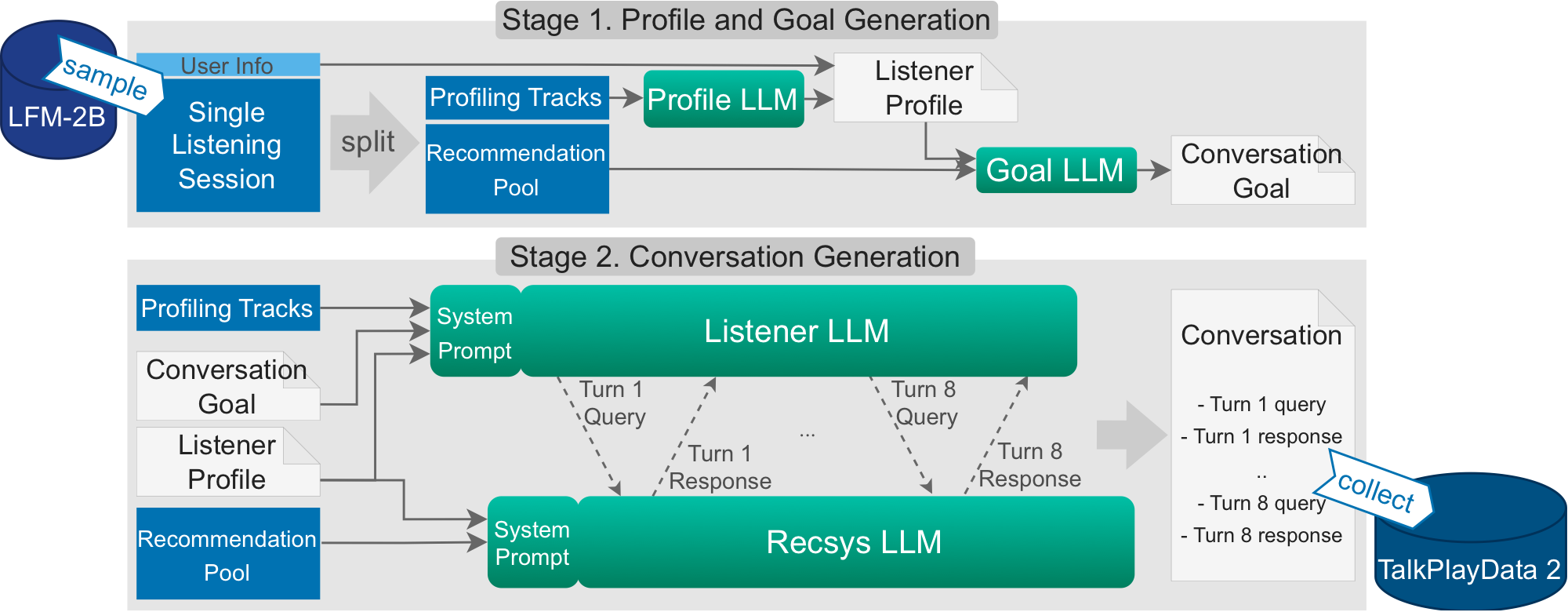
Grounded multimodal data for training conversational recommenders.
TalkPlay-Tools: Retrieval and Reranking with Tool Calling
Task Choose and execute the retrieval operations needed to satisfy each conversational request.
Goal Move beyond a single retrieval method toward a flexible, production-oriented recommendation pipeline.
Method TalkPlay-Tools introduces LLM tool calling as a unified retrieval-and-reranking controller. The LLM plans tool types, execution order, and arguments across structured filtering, lexical search, multimodal similarity, personalization, and generative retrieval, then uses the retrieved tracks to produce a grounded response.
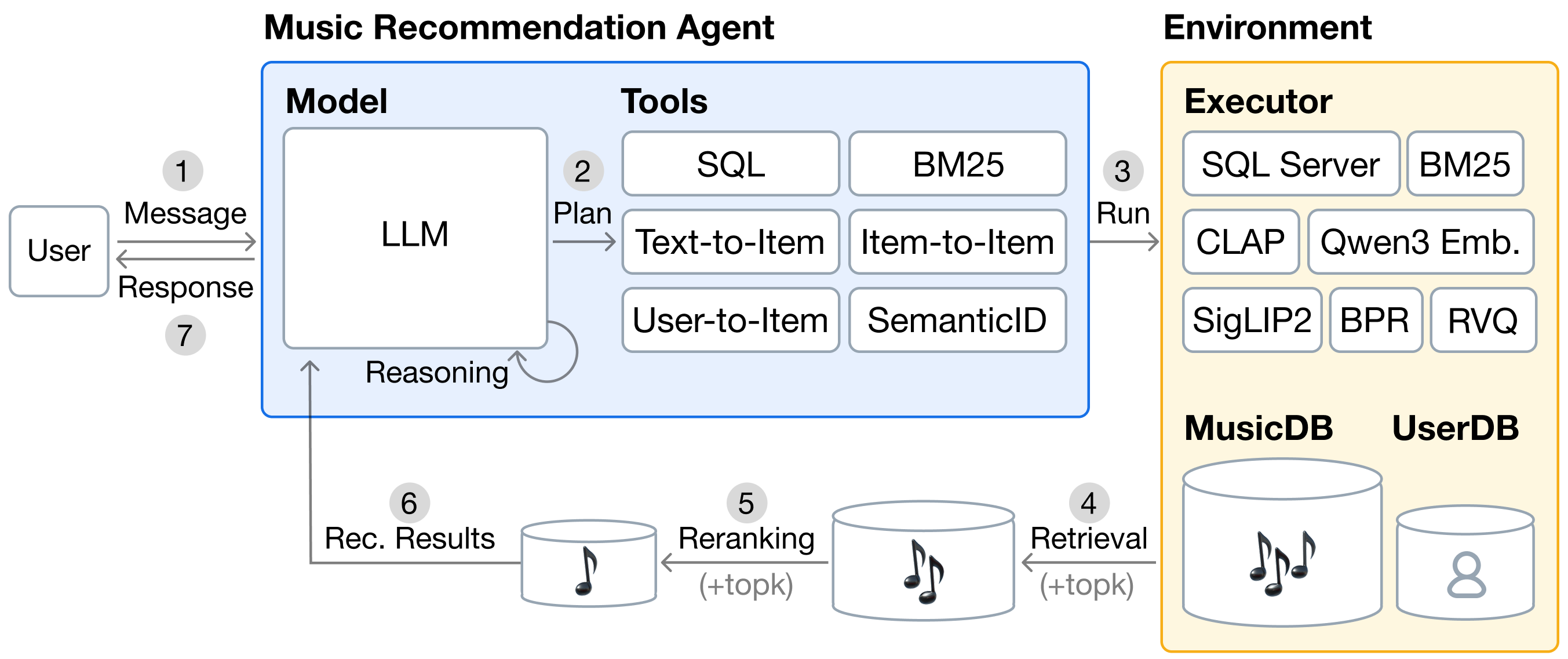
LLM orchestration of specialized retrieval and reranking tools.
Related Publications
-
TalkPlay-Tools: Conversational Music Recommendation with LLM Tool Calling
Seungheon Doh*, Keunwoo Choi*, and Juhan Nam (* equal contribution)
NeurIPS Workshop on AI for Music, 2025
[paper] [project] -
TalkPlayData 2: An Agentic Synthetic Data Pipeline for Multimodal Conversational Music Recommendation
Keunwoo Choi*, Seungheon Doh*, and Juhan Nam (* equal contribution)
arXiv preprint, 2025
[paper] [data & code] -
TalkPlay: Multimodal Music Recommendation with Large Language Models
Seungheon Doh*, Keunwoo Choi*, and Juhan Nam (* equal contribution)
arXiv preprint, 2025
[paper] [project] -
Music Discovery Dialogue Generation Using Human Intent Analysis and Large Language Models
Seungheon Doh, Keunwoo Choi, Daeyong Kwon, Taesu Kim, and Juhan Nam
Proceedings of the 25th International Society for Music Information Retrieval Conference (ISMIR), 2024
[paper] [code & data]