
Expressive Sound Synthesis
Main Contributors: Hounsu Kim, Dabin Kim
Expressiveness is a fundamental element in music, providing a rich experience to the audience. Modeling expressiveness is challenging due its intricacy and diversity within real-world music data. This research field focuses on modeling musical expressiveness for various musical instruments, leveraging recent deep generative models.
Expressive Acoustic Guitar Sound Synthesis
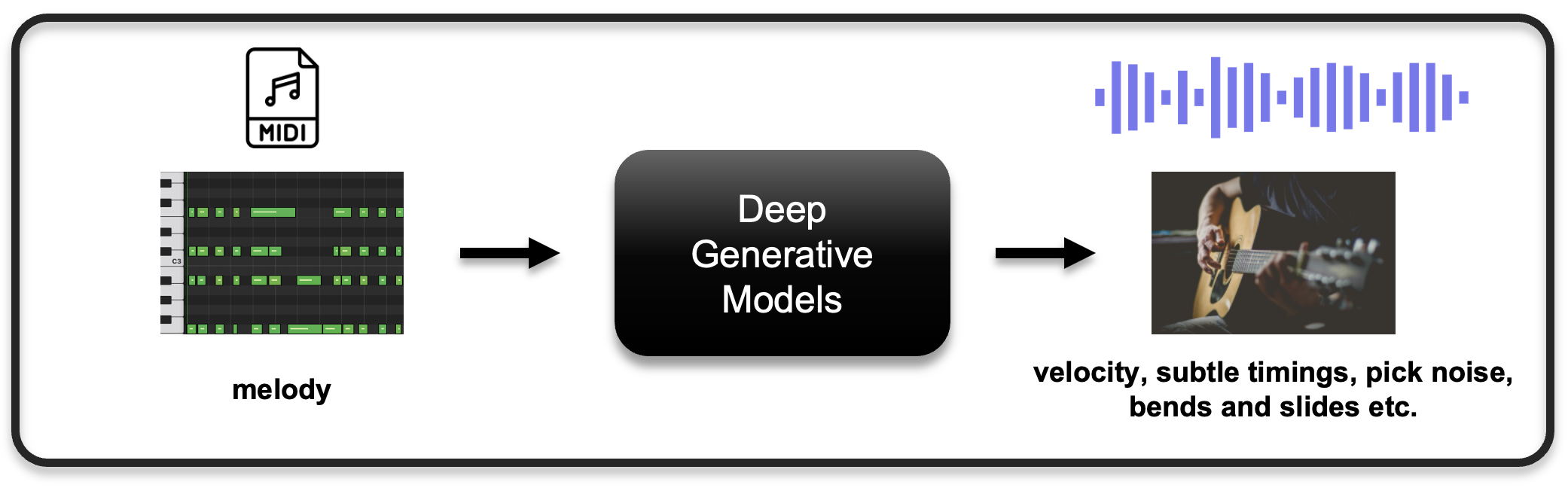
In modern days, music production extensively employs Digital Audio Workstations, where MIDI (Musical Instrument Digital Interface) serves as the primary format for music manipulation.
In these cases, imbuing expressiveness into MIDI to achieve realistic audio rendering is a vital yet challenging task, commonly referred to as MIDI-to-audio synthesis.
Current off-the-shelf methods heavily rely on sample-based synthesis using prerecorded, high-quality audio samples.
However, sample-based synthesis typically lacks the necessary flexibility to faithfully capture the extensive range of acoustic nuances inherent in expressive musical instruments.
This work focuses on the case of acoustic guitar instrument, which is known for exhibiting subtle yet clear differences between audio recordings of realistic performances and those generated solely through MIDI.
Musical Instrument Timbre Transfer
Musical instrument timbre transfer aims to transform the instrumental identity of audio tracks while preserving core musical content such as melody and rhythm. This task becomes especially challenging when the fine-grained structural conditions derived from the source audio contain instrument-specific playing characteristics (e.g., attack transients and vibrato), since these details can lead to timbral ambiguity, shifting the transferred output away from the target instrument's natural timbral distribution.
Motivated by this observation, our work introduces target-adaptive control mechanism to address timbral ambiguity caused by source-derived structural conditions whose fine-grained details may conflict with the target instrument's acoustic properties. Rather than copying all source expressive details uniformly, the method uses text prompts within a ControlNet framework to adaptively scale the frame-wise influences of pitch and loudness controls, allowing the model to attenuate or emphasize those details in accordance with the target instrument's identity.

Related Publications
-
Expressive Acoustic Guitar Sound Synthesis with an Instrument-Specific Input Representation and Diffusion Outpainting
Hounsu Kim, Soonbeom Choi and Juhan Nam
Proceedings of the IEEE International Conference on Acoustics, Speech and Signal Processing (ICASSP), 2024
[paper] [demo] -
AdaTT: Text-Guided Instrument Timbre Transfer with Target-Adaptive Structural Control
Dabin Kim, Junwon Lee and Juhan Nam
Proceedings of the 27th Annual Conference of the International Speech Communication Association (INTERSPEECH), 2026
[paper] [demo]